
From Prevention to Progress: Strengthening Drug-Free Communities in Meridian and Lauderdale County

Preventing youth substance use takes more than telling young people to “just say no.” Effective prevention begins with understanding a community, identifying the risks young people face, building partnerships, choosing strategies that fit local needs, and measuring whether those strategies are making a difference.
That comprehensive approach is at the heart of the work being carried out by The Montgomery Institute/Community Health Improvement Network’s Drug-Free Communities (TMI/CHIN DFC) Coalition in Meridian and Lauderdale County.
As the coalition’s work continues to grow, so does its commitment to ensuring local prevention efforts are informed by proven practices and the best tools available.
Recently, DFC Project Director Lacey Williams participated in the Strategic Prevention Framework Application for Prevention Success Training (SAPST), held [DATES TO BE ADDED]. The Prevention Technology Transfer Center Network (Southeast) provided the training at no charge to participants.
For Williams, the experience provided new knowledge and practical tools that can be applied directly to the coalition’s prevention work in Meridian and Lauderdale County.
Drug-Free: A Framework for Effective Prevention
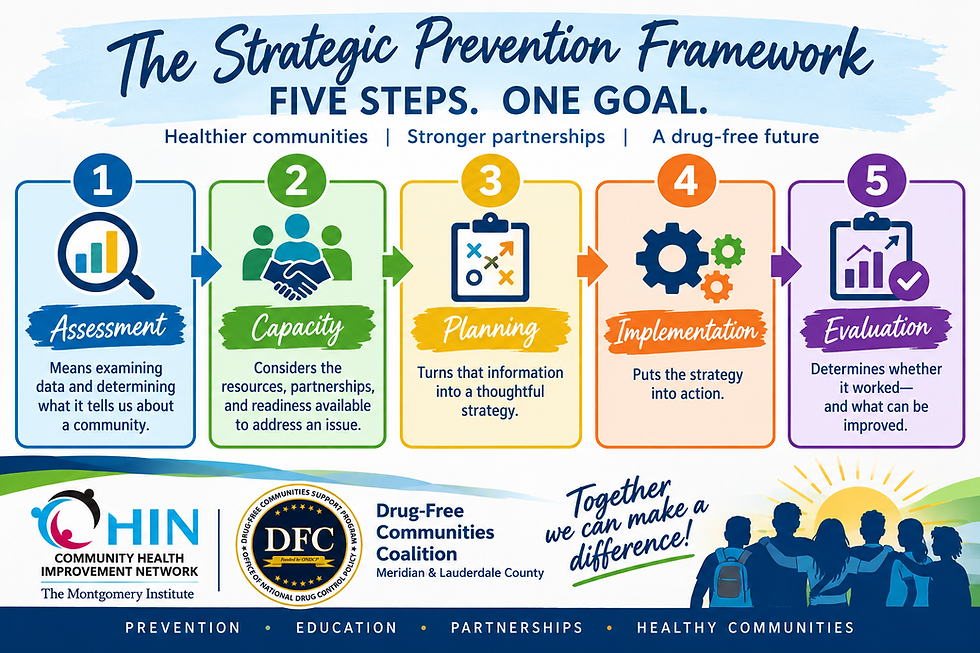
During the training, Williams studied the five steps of the Strategic Prevention Framework (SPF): Assessment, Capacity, Planning, Implementation, and Evaluation.
Those five words represent an important philosophy behind successful prevention: communities should understand a problem before attempting to solve it.
Assessment means examining data and determining what it tells us about a community. Capacity considers the resources, partnerships, and readiness available to address an issue. Planning turns that information into a thoughtful strategy. Implementation puts the strategy into action. Evaluation determines whether it worked—and what can be improved.
For TMI/CHIN DFC, this framework complements work already underway in local schools and throughout the community.
The coalition has worked with middle and high school students in Meridian Public School District and Lauderdale County Schools, using prevention campaigns, educational materials, videos, worksheets, and discussions to increase awareness about drugs and substance use.
Students have participated in activities that begin with seemingly simple questions such as, “What is a drug?” and “What isn’t a drug?” Those questions open the door to larger conversations about substances, their effects, misconceptions surrounding drug use, healthy decision-making, and the choices young people encounter as they become increasingly independent.
The response to the school initiative has been highly encouraging, and a more comprehensive update on the program and its impact will be forthcoming.

Understanding Risk—and Building Protection
One important component of the SAPST training focused on risk and protective factors within communities and among specific populations. Participants also explored different approaches to prevention and learned to distinguish among Universal, Selective, and Indicated Prevention methods.
That distinction matters.
Youth substance-use prevention cannot rely on a one-size-fits-all approach. Young people live in different circumstances, encounter different pressures, and have different levels of support. Effective prevention requires communities to recognize those differences while also strengthening the factors that help young people succeed.
For the DFC Coalition, prevention is therefore about more than focusing on what youth should avoid. It is also about creating an environment where they can grow confidently, make informed decisions, develop independence, build healthy relationships, and recognize that their futures are worth protecting.
Schools are essential partners in that effort, but they cannot do it alone.
Building Community Capacity
The word coalition is central to the Drug-Free Communities model.
Williams has worked with educational and community leaders to build relationships that extend prevention beyond a single classroom, school, organization, or campaign. TMI/CHIN DFC has continued developing partnerships that bring different voices, resources, and areas of expertise to the table.
The SAPST training reinforced the importance of this kind of capacity building. Participants learned that capacity depends on both resources and readiness, and explored how communities can determine which issues they are prepared to address effectively.
The training also addressed community relevance—an especially important consideration for local prevention work. Williams learned strategies for prioritizing risk and protective factors based on their importance and how realistically they can be changed, as well as ways to strengthen community capacity when prevention efforts encounter opposition.
In other words, effective prevention is not simply about finding a program that worked somewhere else. It is about understanding our community, our youth, our resources, and our challenges and using that knowledge to determine what can work here.

From Good Intentions to Measurable Results
Perhaps one of the most valuable aspects of the Strategic Prevention Framework is its emphasis on accountability.
During the final portion of the training, Williams explored how to identify evidence-based interventions and evaluate them for effectiveness, practical fit, and conceptual fit within an individual community. Training also addressed program fidelity, appropriate adaptation, monitoring, and evaluation.
Just as importantly, participants learned the value of sharing evaluation results—not only to demonstrate progress, but also to promote accountability and increase momentum.
That emphasis will become increasingly important as TMI/CHIN DFC continues its work.
The goal is not simply to count how many presentations are delivered, or worksheets are completed. The larger question is whether prevention efforts are increasing awareness, strengthening protective factors, changing attitudes and, over time, contributing to healthier choices among young people.
"I want the work TMI/CHIN DFC does to be an effective contribution to the bright future of our community here in Meridian and Lauderdale County," said Lacey.

Looking Toward a Healthier Future
Williams described the SAPST experience as “phenomenal” and said it provided insightful tools she is excited to put into practice through TMI/CHIN DFC in Meridian.
That enthusiasm comes at an important point in the coalition’s development.
Work in Meridian and Lauderdale County schools is building momentum. New community partnerships are strengthening the initiative. Students are participating in prevention education designed to help them understand the realities of substance use while developing the confidence to make healthier choices.
The next step is to build upon that foundation strategically—assessing needs, strengthening partnerships, planning carefully, implementing effectively, and evaluating results.
Because ultimately, Drug-Free Communities is about more than preventing substance use. It is about helping young people recognize their potential and giving them the knowledge, support, confidence, and community connections they need to pursue it.
When our youth thrive, our schools grow stronger. Families grow stronger. And Meridian and Lauderdale County grow stronger with them.
Enjoy this photo gallery highlighting the workshops:


Comments